

Our solutions are called "Electric Plaza" and were designed by OneWedge around the needs of electric fleets of commercial vehicles.
La The first of these Electric Plazas went live on February 21, 2022 in Brandizzo (Turin) for the company Teamwork, the starting point of an ambitious installation programme.
The Electric Plaza was designed around the needs of electric logistics fleets, but it can be adapted to electric fleets of any kind.
Why?
Only a few months remain before the traffic ban for Euro5 diesel vehicles comes into force in the large cities of the Po Valley. Originally planned for 2023, it was postponed by two years, which expire in September 2025 for cars, and in 2026 for commercial vehicles.
This map highlights the municipalities of Piedmont, Lombardy and Veneto where these traffic restrictions will apply, which matter especially for fleets using hundreds of thousands of vans under 35 quintals.
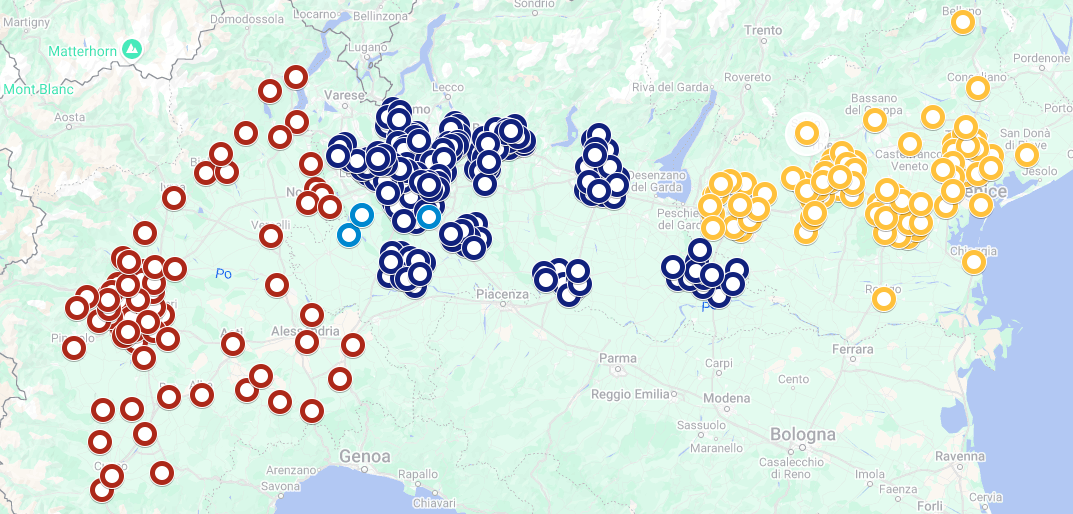
According to UNRAE, at the end of 2024 only a third of the vans on Italian roads were Euro6; professional fleets are certainly renewed more often (so they are newer than average), but this is the reason pushing operators to speed up the migration of their fleets to electric.
But these huge fleets have to be charged every night: what are the possible answers?
- DEPOT - by installing charging stations in warehouse car parks; a low-cost, quick solution and certainly the first to pursue... at least as long as space (and electrical power) is available.
- PUBLIC NETWORK - which (contrary to what propaganda says) is fairly widespread and under-used. But this charging has to happen during working hours, and while a traditional refuel takes a few minutes, a full charge (even at a fast station) takes at least three quarters of an hour.
- DRIVER'S HOME - in practice the company installs a wallbox at the driver's or assignee's home and reimburses the electricity drawn. Simple and cheap, but if you have hundreds of vehicles and/or high staff turnover, it's a real headache. And if the driver or assignee happens to live in a city flat, what was "simple" quickly becomes "complicated".

In short, each solution has pros and cons, but what we have seen in our (still too short) experience is that companies tend to adopt a cocktail of all of them, favouring one or the other depending on the situation, yet leaving a very significant part of the fleet uncovered, for which none of the three solutions is feasible or affordable.
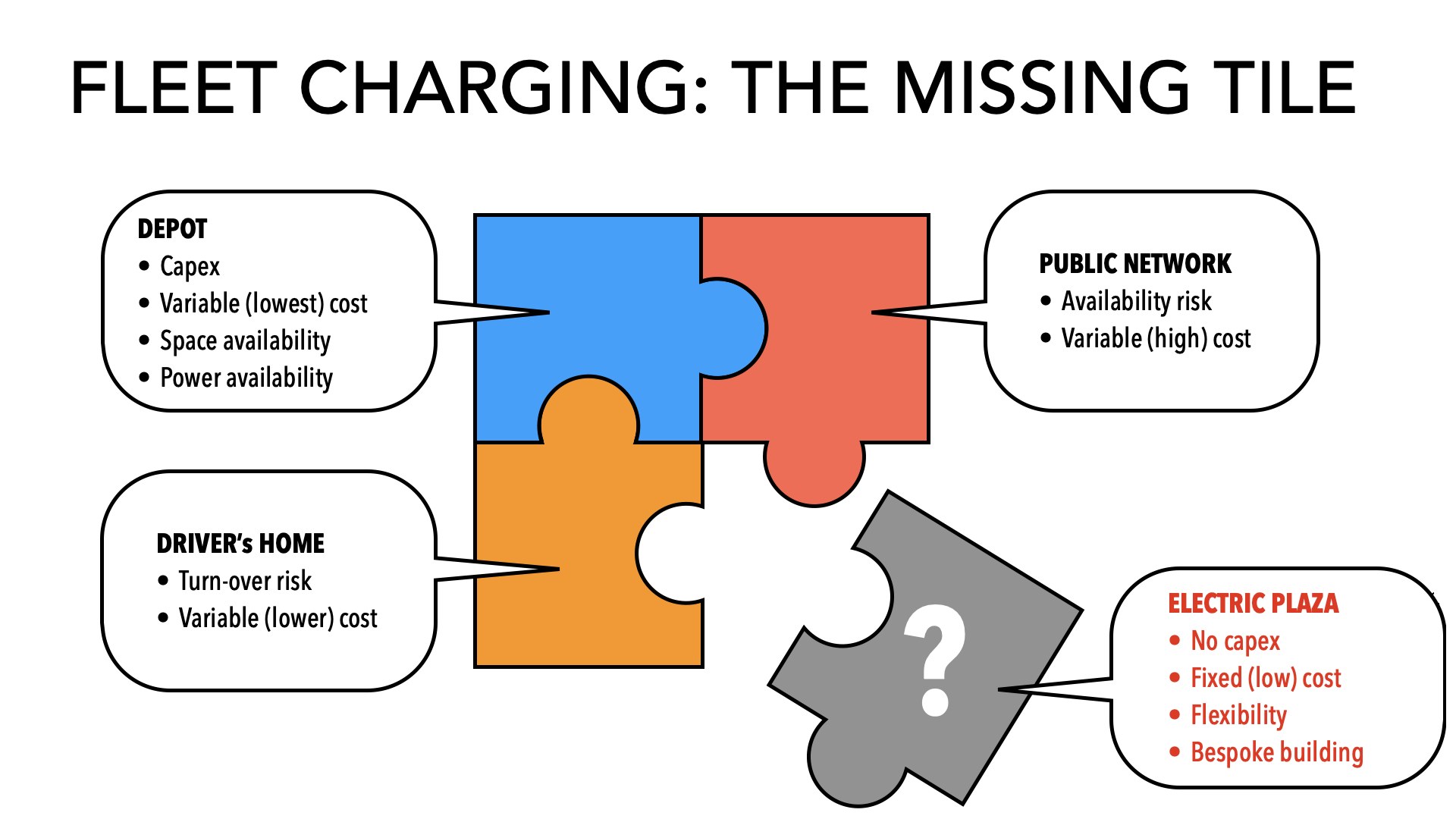
This is precisely the raison d'être of OneWedge's Electric Plazas, which complete the mosaic of charging solutions for fleets: an Electric Plaza answers the question with a flexible solution that ties up no capital, is scalable and is built around the company's needs
Last but not least, at surprisingly low rates.
Where?
How do we decide where to build an Electric Plaza?
Planning plays an extremely important role in our work, because our investors require the sure and fast returns we can offer thanks to the high utilisation rate of our sites.
But how is the utilisation rate (OR, occupancy rate) calculated? At OneWedge we chose the strictest (and most unforgiving) metric, namely the ratio of energy delivered to energy deliverable: for example, a charging station connected to the grid at 20kW that delivers 25,000kWh in a year will have an OR of:
25.000 / (20 x 8.760*) = 14,3%
* hours in a year
CPOs running the public network know well that the OR of a public station is below 1%, while a strategically located Electric Plaza can exceed 25% (for the record, the EP with the highest OR recorded so far runs at 42%).
So understanding "where" is crucial, and to do it OneWedge has developed an algorithm called OneWedge Prospector which combines public and proprietary geographic information to identify the most promising areas.
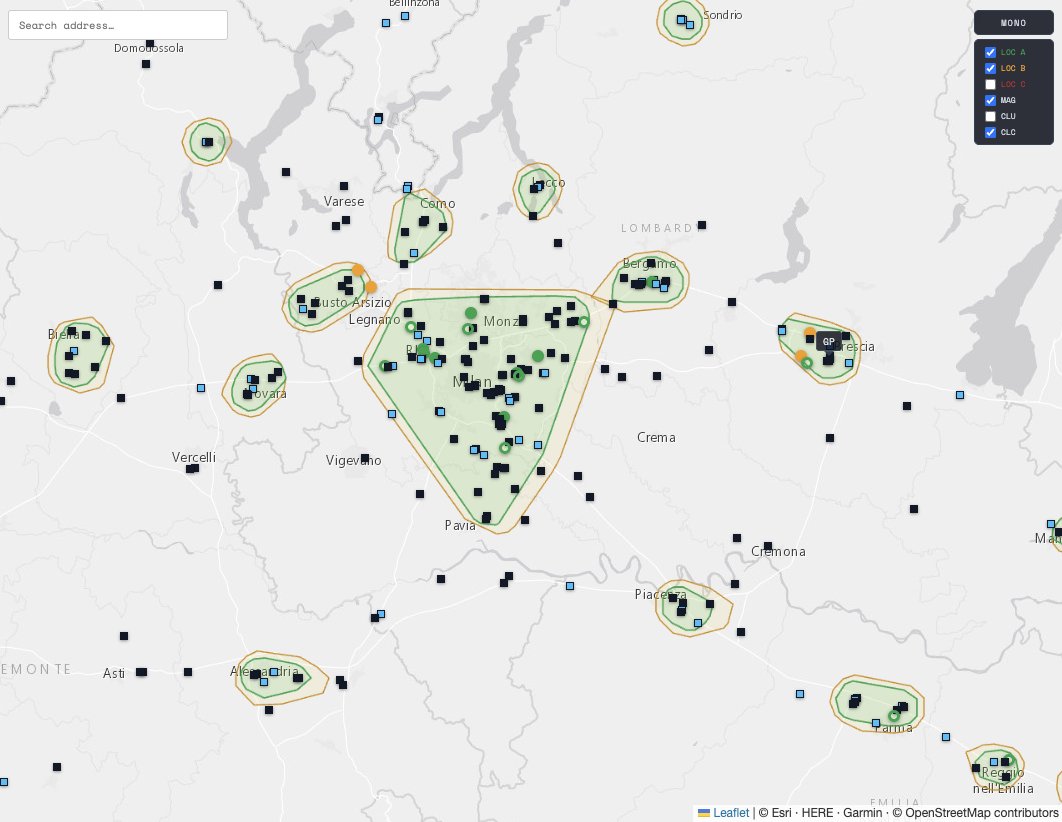
This, for example, is the mapping produced by Prospector for logistics in Northern Italy, with clusters of candidate areas highlighted in green and orange.
Prospector is available for Italy and Germany; versions for the UK, Belgium, the Netherlands, Switzerland and Austria are coming, with other countries to follow.
Besides its location, the plot must have other features to be considered, for example:
- compatible zoning
- available electrical capacity
- building permit
Once the whole checklist is complete, the land can be acquired and construction can start.
How?
Without getting too technical, let's talk a little about HOW Electric Plazas are built, starting with their size.
Here there is a real discontinuity: low-voltage (LV) sites range from 20 to 40 charging bays, while medium-voltage (MV) sites start at 150 and can exceed 1,000 bays. The intermediate size (between 40 and 150) does not optimise the investment, especially as regards the transformer substation.
Physically, the site looks like a car park, with the difference that, being reserved for electric vehicles, the parking/charging bays need not be asphalted, as there is no fluid leakage.
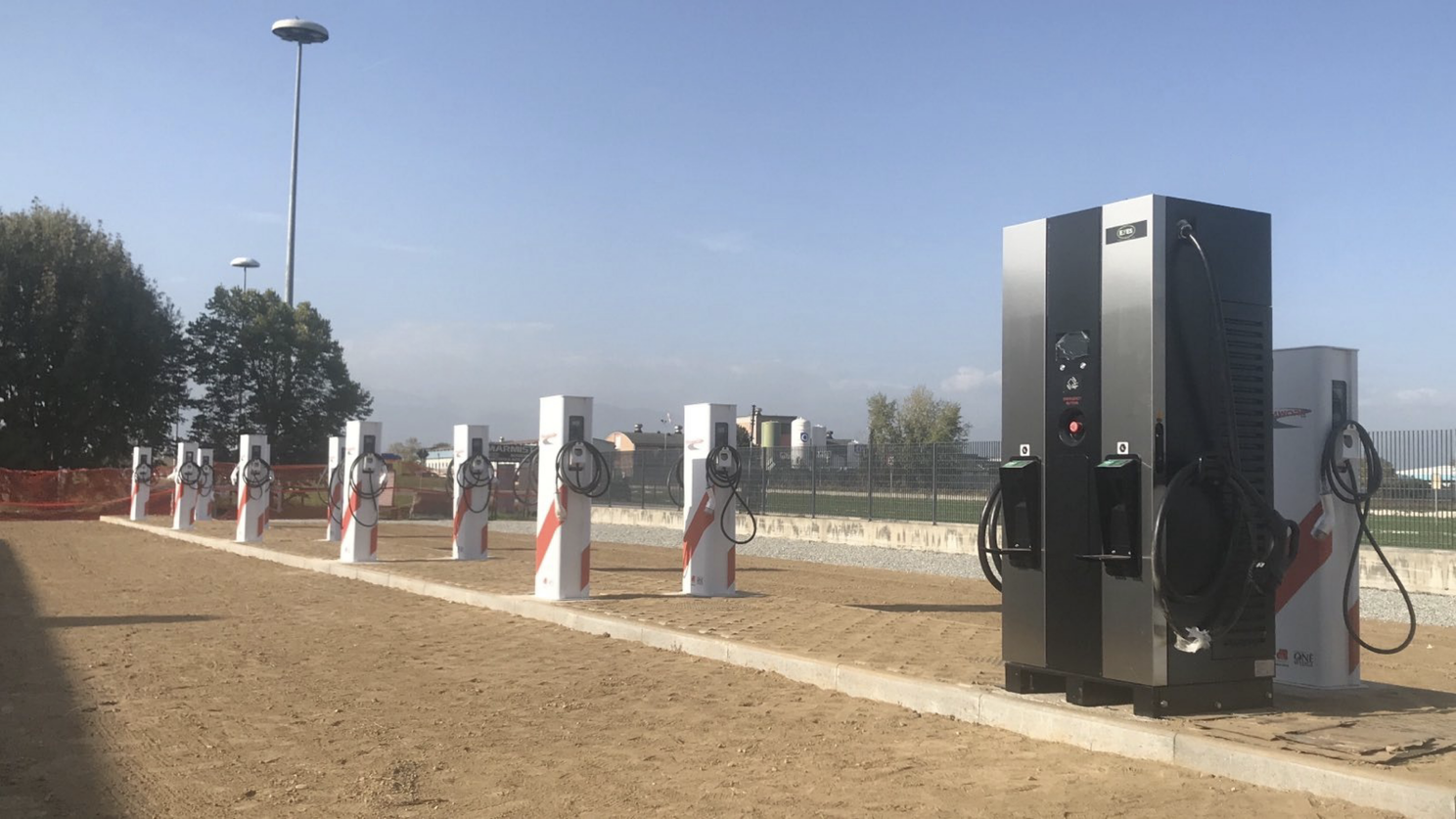

Every two bays there is an AC charging station that can deliver up to 22kW (although vans almost always charge at 7 or 11kW) and - at the client's discretion - Fast stations (usually around 100kW maximum) can be added for quick top-ups when needed.
Since the sites are not open to the public, access is controlled and charging sessions are enabled by software, which also spreads the delivery of energy over the available time window to avoid costly demand peaks.
The driver parks, plugs in and doesn't need to worry about anything else: in the morning the van will be 100% charged, ready for the delivery round.
The installation includes measures to minimise (if not eliminate) the risk of interrupted sessions: from buffer batteries that suspend sessions during power outages, to all-metal hardware, auto-reclosing protections and redundant communication lines so as never to lose the connection with the servers running the control software; everything is designed for a "mission critical" use case: while a consumer who finds a station out of order simply drives to the next one, an Electric Plaza customer's van that doesn't charge overnight can't work in the morning: a radically different perspective.
Contact
Book a visit now and we'll explain how you can already make this transformation simply and affordably.